Rust for Agentic Coding
Of all the languages I've used so far for "no-look" programming in order to explore code-authoring abilities of new models, Rust is by far the one with fewer issues.
I'm on the cheapest subscription plan for multiple agentic coding tools (Claude Code, Antigravity, Codex, grok), and I frequently use multiple tools after I hit token limits. Also, this isn't some complex multi-agent orchestrator like Orca or Conductor – this is just me using herdr/tmux + Termius + Tailscale on my phone, switching from one terminal CLI to another.
For a level playing field between AI harnesses, this a barebones set up – no complex harness instructions other than what comes with the agentic tools. There are a small set of common agent skills that are compatible with multiple providers, that let me track progress and handoff work via simple file-based ledgers.
List of languages I've tried: go, TypeScript, Python, Rust. Rust is the last among the languages I used, so to prevent any recency bias, I reimplemented an earlier golang project in Rust. The lines of code for the rust implementation were more (haven't checked why, but it kinda makes sense since ownership of shared data is tracked at a lower abstraction layer). By default, the rust files are also less modular – many instances of huge files with logic stuffed in them, unit tests in #[test] blocks that bloat file sizes.
Perhaps it's the inlined tests that keep the AI true, playing the role of a forcing function to ensure that it doesn't leave empty implementation stubs and happily claim that the task was completed. Maybe it enforces error-first thinking or induces edge-case considerations instead of vanilla happy-path implementations.
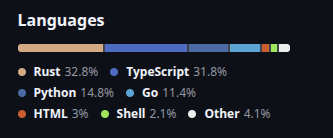
But across gemini-3.8-flash (medium, high), gpt-6.1-sol or gpt-6-luna (medium), Sonnet 5.5 (medium), Opus 5.5 (medium), rust output has been consistently aligned with instructions and spec provided. The rust build process tends to be slow (despite incremental builds), and the filesystem gets bloated from past builds, but the tasks do get executed smoothly. That gives me the impression that, in practice, the stdlib, programming lexicon, and language-tokens Rust exposes are more aligned with the AI coding CLIs available today at an LLM model intelligence level.
A deliberately constrained but sufficient programming language API surface that is more precise in its intent may be what the differentiator is. Perhaps I'll have a future post back this up with data.
For most throwaway projects, antigravity CLI does a fine job. To be honest, after a well planned ledger is generated via Opus 5.5, a set of cheap but capable programming implementers work brilliantly, and agy is commendable as a no-look coding harness. Just don't send gemini models on truth-seeking missions, these continue to be plagued with making sh*t up.